Pascal’s Wager
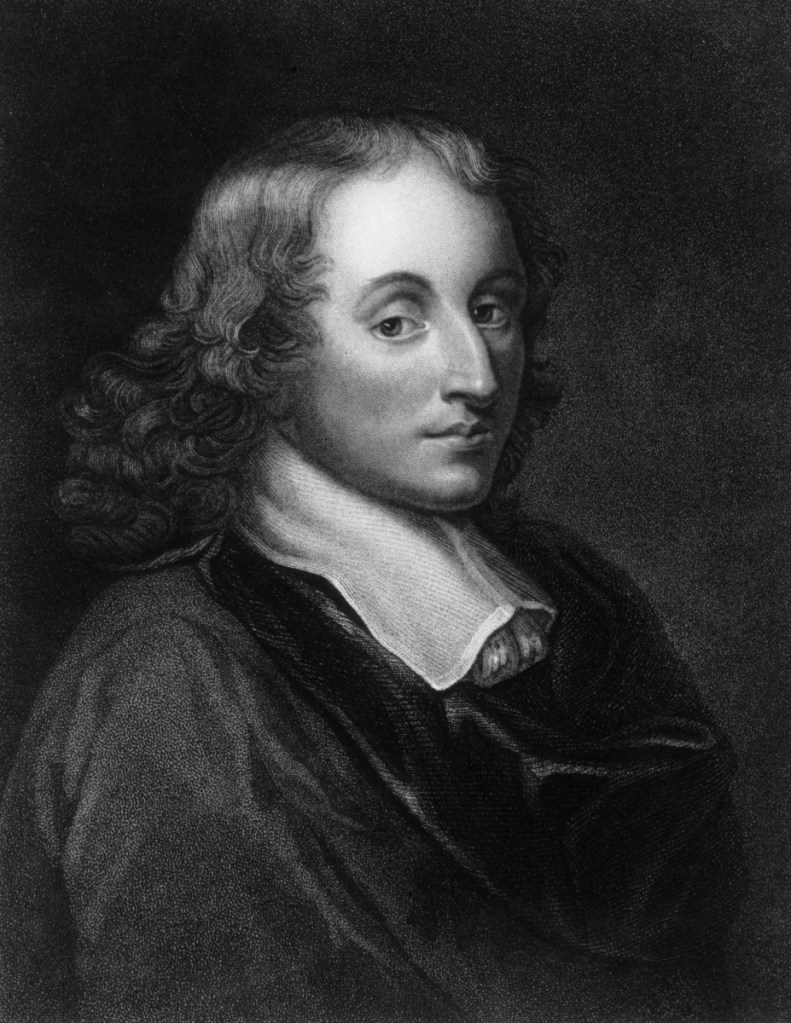
During the 17th century, French mathematician and scientist, Blaise Pascal (1623-1662), began writing a collection of notes titled his Pensées or Thoughts. Among these notes lies an argument known today as “Pascal’s Wager.” This wager proposes that it is more profitable for a person to believe in God than not to because believing offers a greater reward. Pascal does not argue that we should believe in God because it is the moral or “right” thing to do, or because evidence supports the existence of God, but rather we should believe for the simple reason that it is in our self-interest as human beings to do so.
To illustrate Pascal’s Wager in terms of game theory, we can show his argument in the form of a payoff matrix. Pascal assumes that we will ‘play,’ and choose one option or the other; either God exists or God does not exist. This argument is often called the argument from superdominance.
| God Exists | God Does Not Exist | |
| Wager God Exists | Infinite Happiness | Lose Nothing |
| Wager God Does Not Exist | Infinite Sorrow | Lose Nothing |
In Pascal’s eyes, betting on God’s existence is a dominating strategy and betting against God is the dominated strategy, assuming that the possibility of God existing is greater than zero. When one bets that God does exist, they stand to gain an eternity of happiness while essentially risking nothing. If they wager for God and are wrong, they will lose nothing except perhaps some wasted time. Assuming God doesn’t exist and one correctly bets that God doesn’t exist, what do they stand to gain? From Pascal’s argument they stand to gain nothing. While the best-case scenario for a non-believer would be to neither gain nor lose anything, the worst-case would be ‘infinite sorrow’ and an eternity of damnation! With this mode of thinking one would have to be completely irrational not to wager for God, but already we can see Pascal’s argument leaves many questions unanswered.
One problem with this line of reasoning is Pascal’s value for each outcome. For example, Pascal states that if one were to wrongly wager for God’s existence, there would be no harm done.
“If you win, you win all; if you lose, you lose nothing. Wager then, without hesitation, that He does exist.” 1
Depending on one’s motivation of morality, or lack thereof, some people may disagree with Pascal’s assessment of losing nothing. Let’s say a devout man, who very much enjoyed gambling, refrained from going to casinos because he feared it would keep him out of heaven. This man may have a different perspective on losing nothing. If he were to know in advance that there was neither God nor heaven and that upon his death he would simply be ‘pushing up daisies’ as it were, this man would surely have something to lose; a lifetime of pleasure. Had the gambling man known that after death he would cease to exist, we can bet that he probably would have spent more time enjoying himself in Atlantic City or Las Vegas. Similar to this case, Ian Hacking states:
“The libertine is giving up something if the choice is to adopt a pious form of life… If God is not, the worldly life is preferable to the cloistered one.” 2
In Pascal’s second argument, often called the argument from expectation, Pascal discusses one’s decision process in playing, what to bet on, and what the odds are. To play, one must decide whether they think God does or does not exist.
“When there is an equal risk of winning and of losing, if you only had two lives to win, you might still wager; but if there were three lives to win, you would still have to play (since you are under the necessity of playing). and, being thus obliged to play, you would be imprudent not to risk your life to win three in a game where there is an equal chance of winning and of losing.” 3
To illustrate the two examples above, we can diagram them as such:
First Case
Risk one life and win→ gain one extra life (total of 2 lives)
Risk one life and lose→ lose one life (total of 0 lives)
Expected Value (EV) = ½(2) + ½(0) = 1
• because we would be risking one life for an expected value/return of one life, it would be equally wise to play as not to play. “You might still wager.”
Second Case
Risk one life and win→ gain two extra lives (total of 3 lives)
Risk one life and lose→ lose one life (total of 0 lives)
EV= ½(3) + ½(0) = 1 ½
• because we would be risking one life for an expected value/return of 1 ½ lives, we would be foolish not to play. “You would be imprudent not to risk your life…”
By stating there is an “equal chance” to win or lose, Pascal assumes that the possibility of God existing is ½. While this notion may seem absurd considering the lack of evidence, Pascal was thinking in terms of the classical interpretation of probability that gives equal weight to all alternatives (Had Pascal considered three or four choices instead of two, the probability of each choice would have been 1/3rd or 1/4th respectively under the classical interpretation). Besides, the ratio of ½ is irrelevant as it only serves to show that the possibility of God existing is greater than zero. As Rescher says with regard to Pascal’s argument:
“All that matters for his reasoning is that this probability be non-Zer0. As long as there is a finite chance of God’s existence- no matter how small – the expectation of the ‘bet-and-believe’ alternative outweighs that of its rival.” 4
The final argument of Pascal is often referred to as the argument from dominating expectation. In this conclusive argument, Pascal maintains that the possibility of God existing is greater than zero, and though the odds may be thought extraordinarily small, the potential return for wagering on God – infinite happiness – more than makes up for any lack of probability.
The purpose of Pascal’s Wager argument is simply to establish that belief in God can be rationally justified, not to prove that God exists. It has been noted that Pascal himself enjoyed gambling and in his wager he presents not a sure bet but an optimal, if not safe, bet. Though Pascal seemingly demonstrated that to believe in God is more advantageous than to not believe, there are many vague assumptions in his argument that are continually questioned and criticized, including the notions of belief itself.
Questions and Objections to Pascal’s Wager
Can we choose to believe?
One possible question of Pascal’s Wager is his notion of belief. Pascal seems to think that people can force themselves to believe, or at least try to believe in God because it offers the greatest reward. The argument basically says that one should choose to believe in God for the possible benefits and close their eyes to what they may think is the likelihood of God’s existence. As Richard Foley states:
“The assumption is that the practical benefits of belief are irrelevant to the issue of what it is rational for us to believe.” 5
Many Agnostics share the opinion that, because they have evidence neither for nor against the existence of God, and cannot reasonably believe one way or the other, it would be irrational to choose either side of the issue.
Is belief enough?
From reading Pascal’s arguments, he seems to assume that simply believing in God will be enough to grant us salvation and a place in heaven. There are many who criticize this because they feel entrance into heaven will be determined not just by one’s beliefs, but by their deeds as well. Many Christian traditions share the belief that faith alone (or an attempt at it) is not enough. Some believe that one must also be baptized, or live a moral life, or attend Mass every week to be eligible for eternal happiness. Whatever their practices may be, many feel that belief alone is just not enough.
What if there is more than one God?
Though we know that Pascal was referring to belief in the single Christian God, what if there is in fact more than one God? For Christians, Muslims, and Jews alike, God forbids the worshipping or belief in any other God. If these are all in fact separate Beings, which one is the right one? Pascal seems to dismiss or ignore this possibility and therefore leaves the question, “Which God should I wager on?”
Is this the manner in which God wishes to reveal Him/Herself?
If one assumes that there is indeed a God above, we must consider whether or not he/she would want to reveal him/herself through game theory. Supposing that an omnipotent being exists and has placed us humans here in this world, would they really want our faith and our beliefs in them to be based on mere “calculations” and an advantageous bet? It seems rather profane to think that the ultimate life force should be seen through a looking glass of probabilities, statistics, and a supreme gamble with the best pot-odds.
Pascal’s Wager is most certainly a valid and somewhat comforting proposition, but it seems to degrade religion as a whole, removing the mystical uncertainty of life and what may or may not follow, while replacing this lack of knowledge with an avarice for immortality. No one can provide physical evidence of an afterlife or a supreme creator and, more likely than not, no one will ever be able to. but it is this ignorance that gives life such great meaning and value. Part of the fun in living is not knowing for sure what may come next, whether that be tomorrow, a week from now, or some years down the road when our earthly expedition has come to a close. While Pascal says that reason cannot determine our ultimate future and that “at the extremity of this infinite distance a game is in progress, where either heads or tails may turn up,” one would hope that the “safe bet” is unique from one person to the next.
 dailey.news
You must be logged in to post a comment.