The Chinese Rites Controversy:
How Christianity Failed in China

In 1583, Jesuit missionary Mateo Ricci entered China with a desire to learn the Chinese culture and traditions. With the help of accomplished scholars, Ricci acquired a great understanding of the Chinese classics and gained the respect of many in China, soon serving the Emperor at the Imperial court. Through his respect for Chinese culture, and diligence in studying it, Ricci fostered a connection between China and the Society of Jesus while successfully converting many Chinese citizens to Catholicism. In the century following his death, Dominican and Franciscan missionaries joined the Jesuits in spreading the Catholic faith throughout China. Before long, Jesuit missionaries received much criticism for their conversion methods from Dominicans, Franciscans, and eventually the Catholic authorities in Rome, all of whom believed that the Jesuit methods sacrificed the sanctity of their traditions. As the conflict developed, Chinese culture was inadvertently belittled, the Chinese view of Christianity soured, and the pioneering work of Mateo Ricci was overshadowed by religious debate. By not treating Chinese culture and traditions with more reverence and respect, the Pope and Dominican missionaries slowly negated Ricci’s contributions to the founding of a Catholic Church in China.
As European missionaries began efforts to penetrate and convert China to Christianity in the mid-16th century, they became increasingly aggravated with their failed attempts. Jesuit missionaries such as Juan Baptista Ribeira and Francisco Peres made no effort to learn the Chinese culture, but in their vanity felt slighted when the country did not embrace them. The self-important sense of Europeanism shared by most missionaries was a real obstruction; it irritated the Chinese they came in contact with and prevented them from being welcomed into Chinese society.1
When Italian Jesuit Alessandro Valignano arrived in Macao in 1577, it marked a new course for the Jesuit missions. Valignano’s positive attitude towards the Chinese people and their traditions contrasted with the pervading opinions of his European-Christian contemporaries who felt that converting China was impossible unless an aggressive stance was taken. Valignano approached Chinese civilization deferentially and formed a new Jesuit mission that strove to integrate with and adopt Chinese culture, abandoning the self-aggrandizing European mentality and methods of previous Jesuits. Referring to one of the practices employed by Jesuit missionaries with their Chinese converts in Macao (a city occupied by many Portuguese merchants who used it as a trading post) Dunne states that Valignano “ordered the abandonment of the policy of ‘portugalizing’ converts. Chinese Christians were to remain Chinese. Instead of ‘portugalizing’ them, the missionaries were to ‘sinicize’ themselves.”2
As Valignano endeavored to reach the Chinese from a more Sino-logical angle, a young Jesuit was transferred to his mission who would become the pioneer of Christian labors in China. Mateo Ricci, arriving in Macao in 1583, owned a humble disposition that allowed him to earn the admiration of Chinese scholars and officials whom he engaged in thoughtful discussions. Already possessing a vast knowledge of Western arts, sciences and geography, Ricci developed a great understanding of the Confucian classics, Chinese psychology, and Chinese culture in general. He was eventually invited to serve at the Wan-li Emperor’s court in the capital of Peking, a great aspiration of the Jesuits who believed that China’s tolerance of Catholicism, as well as the safety of missionaries, depended on the acknowledgment of educated Chinese leaders.3
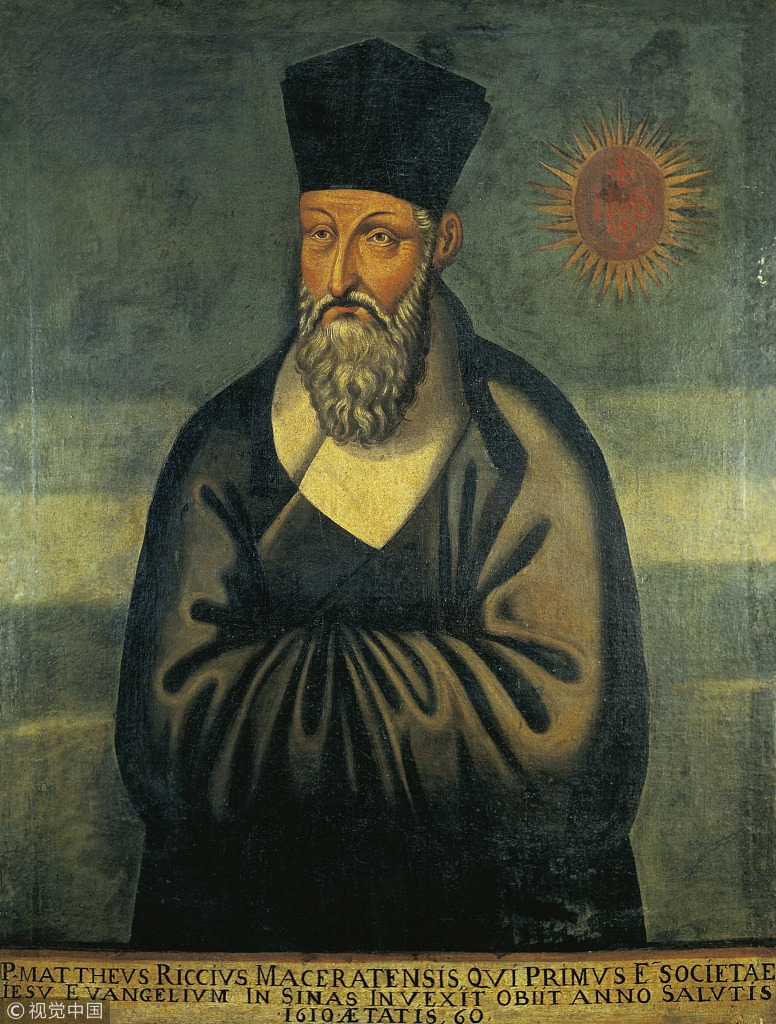
One of Mateo Ricci’s most notable and controversial roles in spreading the Catholic faith resulted from the methods he utilized in converting the Chinese. While Valignano made the first step towards Catholic-Chinese integration, Mateo Ricci brought the idea of gradually mixing cultures a step further. He felt that the establishment of a “Sino-Christian civilization” needed to be rooted in Chinese heritage and that Catholicism would have to allow certain Chinese customs if it were to survive or be of any relevance in the future.4
In adapting the Catholic faith to Chinese culture, Ricci sought to tie Christian doctrine with Confucianism, which he did not view as a religion but as a general philosophy or guideline for living.5 As a result of Ricci’s discernment of Confucian ideology, Jesuit missionaries allowed Chinese converts to continue certain Confucian rites, or practices, not believed to be overtly superstitious. The yearly tradition of venerating one’s ancestors was allowed because in Ricci’s interpretation, Chinese citizens were not actually worshipping the dead, but honoring their memory. Offerings of foods and silks were merely symbolic gifts of remembrance in Ricci’s eyes and were not considered idolatrous in nature. He also allowed the custom of keeping a family tablet with the names of ancestors inscribed on it.6
Another way in which Ricci and the Jesuits accommodated to Confucian custom was by giving the Christian God a Chinese title. The terms used were t’ien (heaven), t’ien-chu (lord of heaven), and shangdi (lord on high), all taken from the Confucian classics. Ricci adopted these Confucian titles to denote the universal and Supreme Being that he linked to the single Christian God.7 Though Ricci was confident in his translations of divine terminology, other Jesuits and Catholic missionaries were unconvinced and believed that applying these terms to Christianity was improper and surrendered Christian principles to Chinese culture.

Ricci’s notion of building a new Catholic tradition upon a Chinese foundation proved to be divisive among Catholic missionaries, not only with the Dominican and Franciscan orders, but within the Jesuit order as well. The idea of modifying Catholic dogma to include Chinese terms and customs later produced a great debate between those Catholics who agreed with Ricci’s method of cultural accommodation, and those that felt he was over-accommodating. In the decades that followed his death in 1610, Catholic missionaries argued over Mateo Ricci’s methods with Chinese converts, and in time the Catholic authority in Rome became involved, delivering its own judgments on Catholic policy in China.
While Jesuit missionaries successfully established themselves in China with Mateo Ricci’s help, Dominican and Franciscan missionaries worked in the Philippines where they set up a flourishing mission at Manila. Though they made attempts to come preach in the mainland of China, they were unsuccessful until 1631 when Angelo Coqui established a mission in Fuan, north of Fuzhou.8
When Dominican and Franciscan friars became aware of the Jesuit methods in converting, and the allowing of Chinese converts to continue performing the rite of venerating one’s ancestors, they were stunned. The Dominicans and Franciscans viewed the ceremony as thoroughly religious and wished to discuss their position with the Jesuit leaders. The Jesuit response was slow to come and the head of the Dominican Order in China, Jean-Baptiste Morales, took his concern over the rites and Jesuit accommodation to Rome.
In 1645, based on the facts presented to him by Morales, Pope Innocent X forbade Christian converts from taking part in the Confucian rite of venerating one’s ancestors. A decade later, in reaction to Innocent X’s decree, the Jesuits sent missionary Martinus Martini to Rome to present their views on the Chinese rites which they felt were distorted by Morales. The new Pope Alexander VII was sympathetic to Martini and the Jesuits’ case that the rite of venerating one’s ancestors was cultural, not religious, and in 1656 he declared that Catholic converts may continue performing the ceremony.9 Because Pope Alexander VII issued a new proclamation, not reversing Innocent X’s previous judgment, there was room for interpretation by the various Catholic missionaries in China, the Dominicans and Franciscans obviously adhering to Innocent X’s ruling, the Jesuits adhering to Alexander VII’s.
In 1704, nearly fifty years after Pope Alexander VII’s decree, Pope Clement XI tried to put an end to the controversy within the Catholic Church regarding the rites. Among other things, his decree stated that the terms t’ien and shangdi were not to be used by Catholics because of their association with Confucius, and the veneration of ancestors, or any participation in the actual ritual itself, was strictly forbidden to Catholics with a punishment of excommunication for those who did not comply. In essence, the Papal decree attempted to separate Confucianism from Christianity.10
Though formally constructed in 1704, Clement XI’s decision was not publicly announced until 1707 when Charles Thomas Malliard de Tournon, the Papal legate sent to China, revealed Rome’s decision in Nanjing. Eight years later in 1715, Ex Illa Die was published, the official apostolic constitution that further supported the decisions made in 1704. The rulings of the Vatican were not received well in China and in a short period of time Mateo Ricci’s, and the Jesuit missionary’s, work came crumbling down.

Upon hearing Pope Clement XI’s decree, Emperor Kangxi was greatly offended. Though Kangxi himself attempted to explain to Rome his understanding of the Rites as philosophical and not religious in nature, his authority on the matter was disregarded and the Pope refused to change his position. Baffled by the Catholic Church’s lack of respect for his official interpretation of Chinese custom, Kangxi became disillusioned with Christianity and the missions in his land, which he had tolerated exceedingly throughout his reign. The Pope’s demand that Catholics in China reject their Confucian past in order to remain Christian affronted Emperor Kangxi who felt a foreign leader was undermining him, his culture, and his control over China.
Losing patience with the unbending Catholic authority, in 1721 Kangxi finally issued his own decree in which he banned Christian missionaries from preaching in China, an expression of his growing distrust of the Catholic-Europeans.11 Though Kangxi’s successors maintained a handful of Jesuits as advisers in their courts, Catholic missionaries all but vanished from China as resentment of the foreigners intensified. Once admired intellectuals from the West, the Jesuits no longer enjoyed the respect from Chinese-scholars that they had in the past. The Jesuits were grouped with the whole of Catholic missionaries, petty foreigners in the Chinese view, never regaining the influence or esteem that they once held in China.
 dailey.news
You must be logged in to post a comment.